API Style
A combined approach is used for the API styling, to allow minimal cognitive effort translating JS examples to F#, while maintaining common F# idioms.
StringEnums
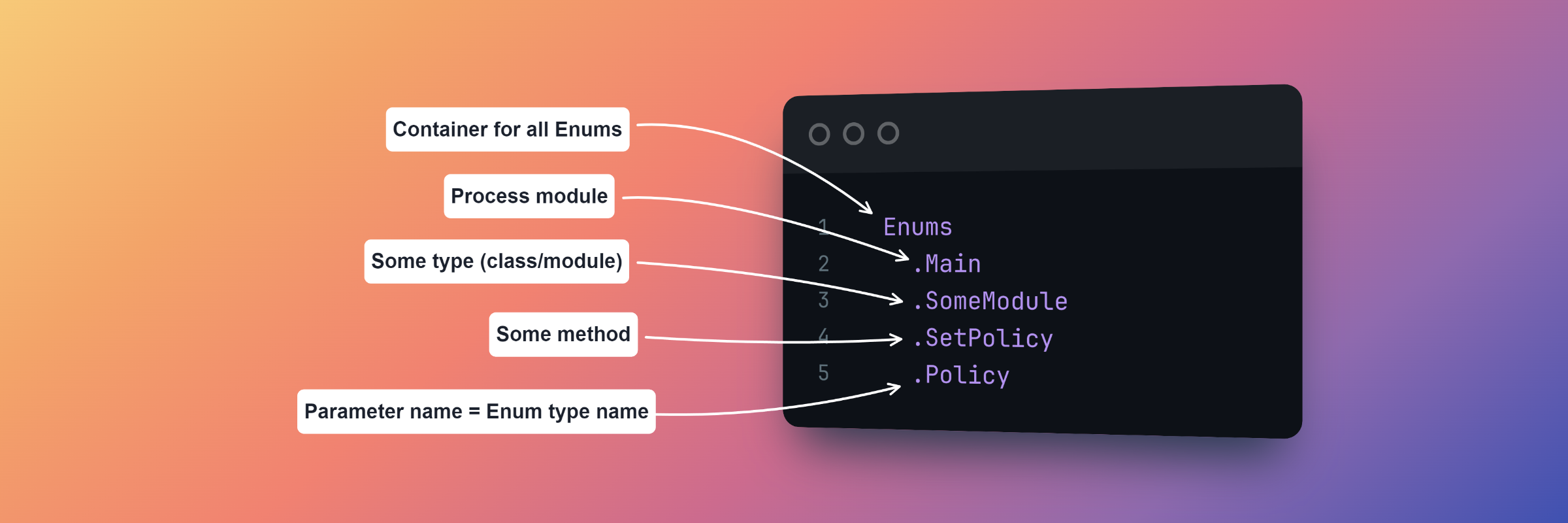
StringEnums are named by the access path taken to navigate to their definition.
The only addendum to this is that they are all contained in a root module Enums.
For example, the string enum for a parameter named policy for method setPolicy
of module someModule in the Main process will be located at Enums.Main.SomeModule.SetPolicy,
with the type name being Policy.
Enums           // <- Container for all Enums
    .Main       // <- Process module
    .SomeModule // <- Some type (class/module)
    .SetPolicy  // <- Some method
    .Policy     // <- Parameter name, and name of Enum type
You can see that the path is styled by typical F# module PascalCase and type idioms.
You can feel free to create abbreviations and other patterns to make access to common enums easier.
Sometimes the path includes a route that is non-congruent to your usage. This is likely because we have abstracted away an options object parameter, meaning your access path is made easier than the real access path.
For the above example, if the method took only an options object with the named property
being policy, then the final access path would be Enums.Main.SomeModule.SetPolicy.Options
with the type name Policy.
JS Modules
Within Electron, there are distinctions between static 'module' like classes (where an instance exists by default), to 'classes' which are created when required.
The 'modules' are cased in camelCase similar to the source material.
All other TYPE definitions utilise PascalCasing.
All other methods and their parameters follow their original naming pattern of camelCase, with the
use of backtick-stropping where required for reserved keywords.
POJOs
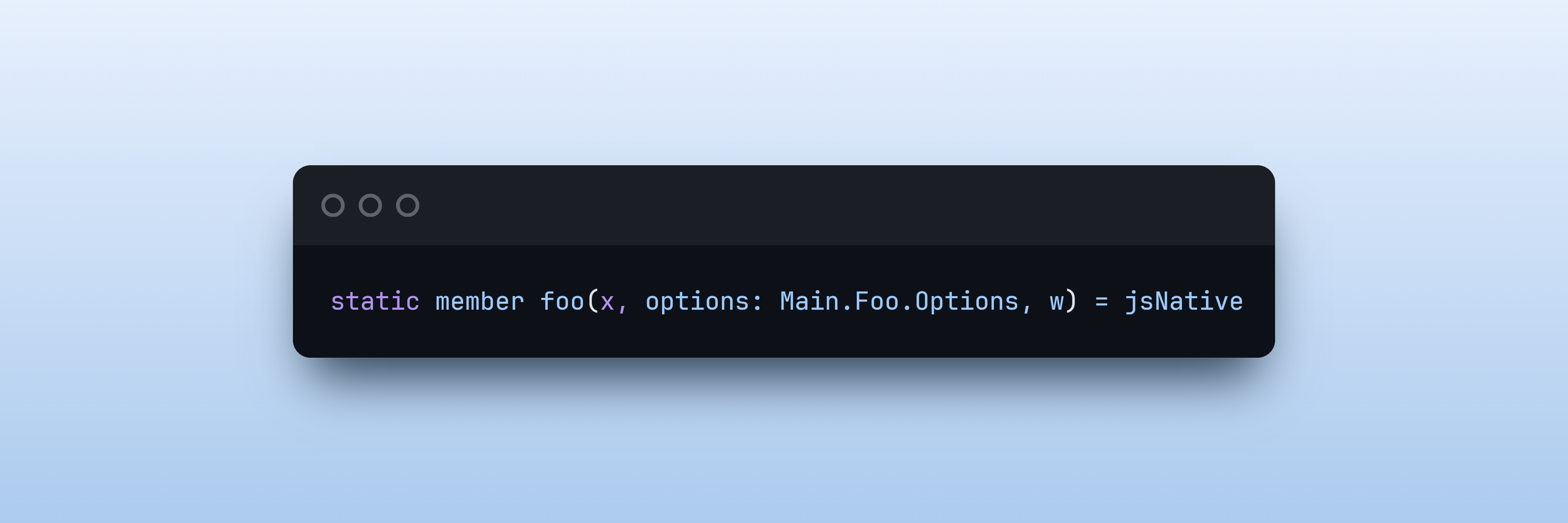
We generate a POJO class definition where a parameter or other API surface uses an options object that we are unable to inline.
Imagine a method signature as follows:
// main.js
function foo (x, options = { y, z }, w) { ... }
As of Fable-5-alpha, attributes for inlining would not be able to manage this.
In this case, we would generate a POJO for that parameter.
The POJOs are located by their access path similar to StringEnums.
Main            // <-- Process module
    .Foo        // <-- Function/method name
    .Options    // <-- Parameter name = Gen Pojo name
And our generated binding for the function above might be something along the lines of:
Structures
In the Electron API, named-POJOs are called structures and are available globally.
These structures are located within an F# AutoOpen module Types.
Events
Where an Event handler/listener has a type signature that is longer than TWO (including the return value),
then we generate both a curried handler signature, and a TWO length typed lambda where the
first type is an interface where you can access the parameters by name, with full
documentation.
These are defined by their access path similar to StringEnums et al.
Unlike POJO's, StringEnum's and Structure's, you typically will not ever
need to access the type definition itself, as you access the members from an
inline function parameter:
fun parameters -> parameters.senderId
Delegates
Where a method parameter, or other api surface, uses a callback/lambda with more than ONE parameter, we create both curried and delegate overloads.
The Delegates are defined by their access path, similar to StringEnums
and POJOs.
The exception is in the case of Event's as described above.